How design opened a new market for Blip before Black Friday
Blip processes over a billion messages a month, but only for large enterprises. Blip Commerce brought payments and authentication to small businesses: a modular product launched before Black Friday that, for the first time, let Blip acquire new clients.

Blip is one of Brazil's leading Conversational AI platforms, processing over one billion messages per month across Latin America and Europe.
The company had always focused on large enterprise clients. But there was an untapped opportunity: small and medium businesses that wanted to add payment and authentication directly into their chat flows, and had no way to do it. The problem was real, and the deadline was tight: it all had to ship before Black Friday.
A new market opened, with 300% ROI and real results for every client.
One invisible barrier, and three problems happening at once.
To access Blip, you already had to be a client. And you cannot market a new tool to people who aren't clients yet.
They were left out
SMBs wanted to add payment and authentication to their chat flows, but the platform wasn't designed for them. The right product simply did not exist for this audience.
It limited the solution
Leadership wanted the solution to live inside the Blip platform. But that created a contradiction: how do you attract new clients with a tool only existing clients can access?
The deadline was very short
The launch had to happen before Black Friday, one of Blip's biggest sales events. There was no room for long discovery or development cycles.
Before designing any screens, we mapped the technical and business context.
The right architecture wasn't obvious, and that single decision would shape everything that came next.
We mapped the existing workflows
Interviewing internal teams to understand how payments and authentication actually worked across the platform, and where the real constraints and dependencies lived.
We benchmarked scalable SaaS models
Studying how other SaaS companies had built scalable payment and authentication products, looking for patterns that could work for small businesses without rebuilding for every client.
Three architectures on the table
We evaluated an extension inside the platform, a build within a specific product like BlipStore, and a modular MFE (Micro Frontend) approach, where the app is split into independent modules that work on their own.
Discovery in motion. Mapping workflows, aligning teams and pressure-testing each architecture option, the groundwork that turned a tight, ambiguous brief into a clear technical direction.
From context to a scalable architecture, decided with the business.
Research & Discovery
Mapped workflows, interviewed internal teams and analyzed industry benchmarks for scalable payment and auth.
Strategy & Ideation
Defined modular principles with leadership and engineering. After testing, MFE was chosen as the most scalable path.
Design & Prototyping
Built responsive flows and reusable components, all aligned to the Blip Design System for consistency.
Testing & Validation
Ran usability tests and pilot sessions with beta clients, refining flows around real business needs.
Handoff & Documentation
Delivered structured docs and architecture guidelines to support the product's long-term evolution.
A modular architecture that unlocked a new front door.
Because each MFE (Micro Frontend) module works independently, we could create a separate entry point for new clients, running external marketing campaigns without changing how the enterprise platform worked. That was the move that solved the project's central contradiction.
Blip Commerce. Payments and authentication providers brought together in one unified, responsive system, contract and cancel when you want, no separate onboarding for each provider.
Instrumented to measure real engagement.
Strategic events were defined and implemented to track button clicks and key interactions. This setup enabled performance measurement and helped validate user engagement throughout the experience.
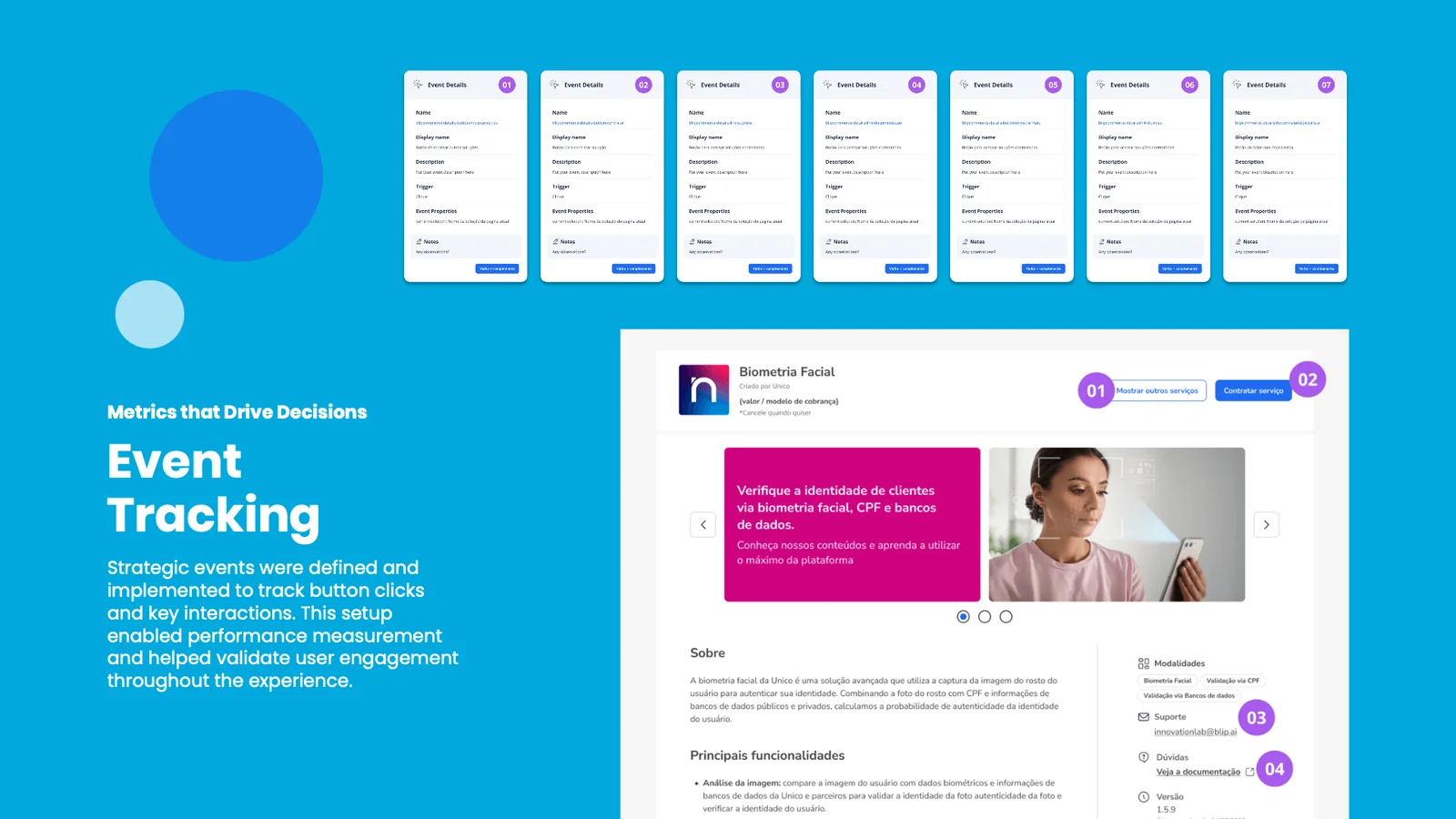
Event tracking. Each meaningful interaction mapped to a measurable event, turning the experience into something the team could read, learn from and improve.
One product, every screen and surface.
From the Blip Commerce hub and provider catalog to biometric configuration, dashboards and the specialist-contact flow, responsive across desktop and mobile, and built entirely on the Blip Design System.

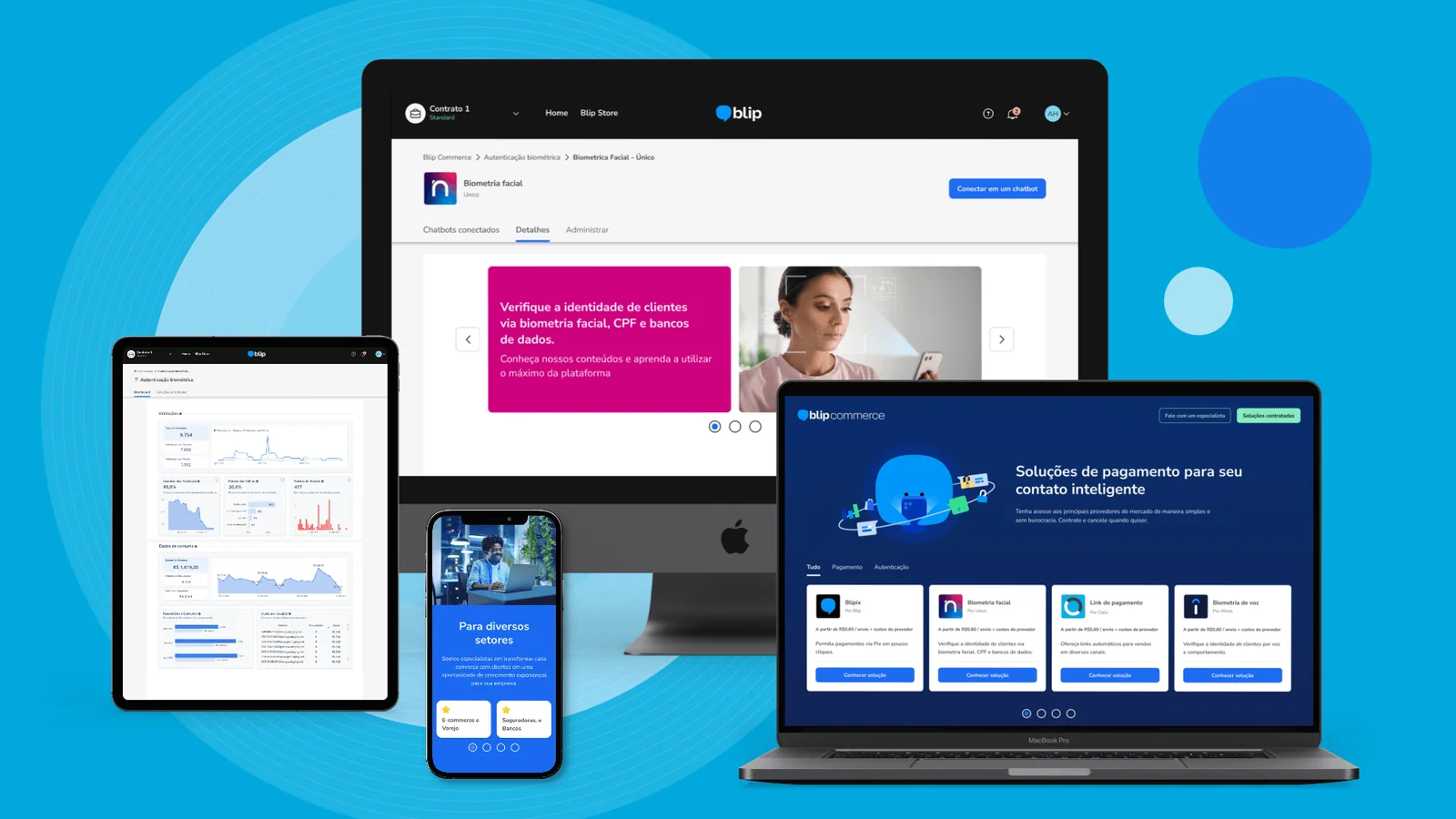
The full experience. The complete flow, from discovery and contracting to configuration and confirmation, designed to feel simple for small businesses while staying reliable at scale.
An effortless handoff, ready to build.
A component-based file with structured flows, business rules and interaction specs, all aligned to the Blip Design System, everything ready for seamless collaboration between design and development.
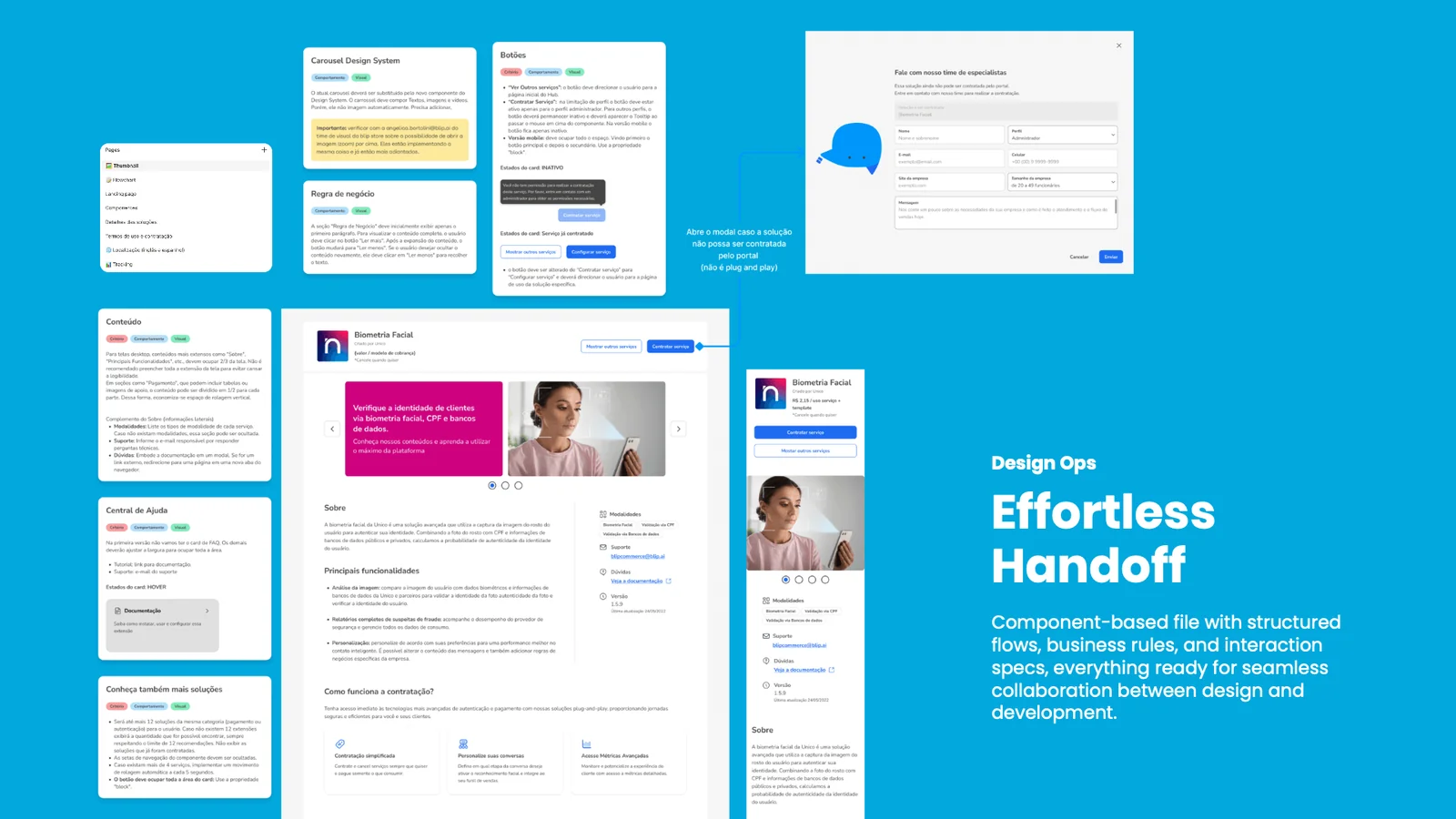
Effortless handoff. Documentation and architecture guidelines that let the product keep evolving long after launch, without losing consistency or context.
What the work taught us.
Plug-and-play is what scales
Without it, every new integration becomes a project from scratch. A modular model is what lets you scale across industries and client profiles.
Scalability needs alignment, not just architecture
Technical decisions have to be made together with the business team, not after the fact.
One unified system beats many onboardings
Companies value access to multiple providers inside a single system. They don't want a separate onboarding for each one.
Early collaboration avoids rework
Bringing design, engineering and business together from the start speeds up decisions that would otherwise slow everything down.
Conversational AI is strategic when it drives results
It becomes strategic when connected to real financial outcomes, not when treated only as a support channel.
Architecture can open markets
MFE wasn't just a technical choice. It was what made a brand-new market possible for Blip.
Strategic design isn't about beautiful screens. It's about the right questions, early.
Blip Commerce showed how chat channels can go beyond customer support and become real tools for generating revenue, delivering 300% ROI for Blip and just as strong results for the clients who adopted it.
Petz recovered R$1.4 million through Pix Open Finance. Abbott reduced fraudulent sign-ups by 50% with biometric validation. Quality saved hundreds of operational hours by automating payment flows. These weren't small improvements, they were direct impacts on each company's business.
More than the numbers, the biggest learning was about process. Bringing together as many perspectives as possible from the start, business, technology, operations and the end user, is what lets you build flows that actually work in real life, not just in a prototype.
The choice to use MFE proves the point. It wasn't just a technical decision: it was what made a new market possible for Blip, letting the company acquire small-business clients independently for the first time.
This project reinforced that strategic design is not about making beautiful screens. It is about asking the right questions early enough that the answers can still change the product.